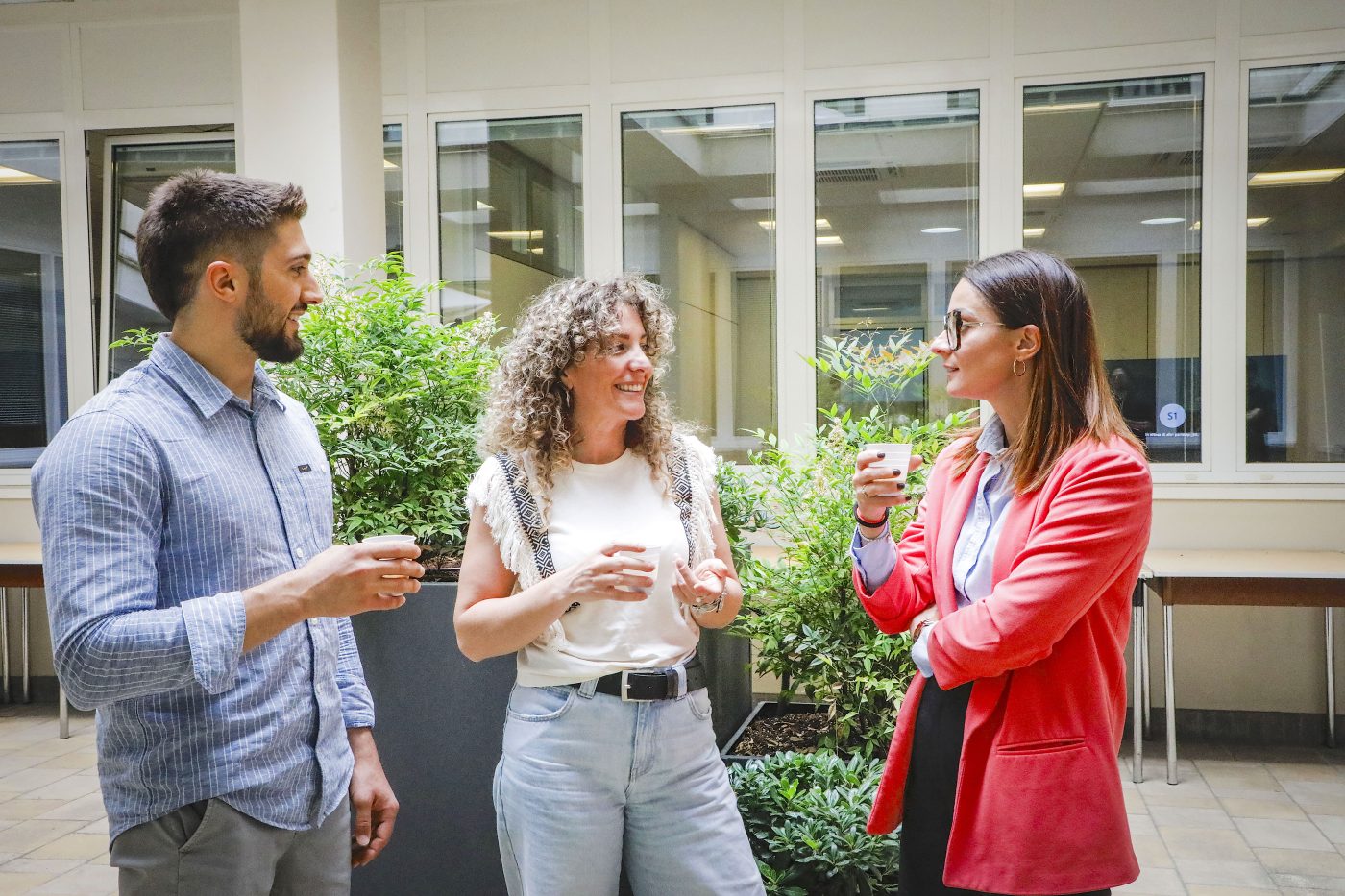

Together we talk about climate neutrality and the responsibility that companies have today, through their people, to lead a change that raises awareness and knowledge and has a positive impact on the planet through their actions.
Alessandra Zamagni:
Hi Paola, it’s nice to finally see you outside our usual settings.
Paola Bertocchi:
Thank you, Alessandra, I’m very pleased too.
Alessandra Zamagni:
In my view, tackling decarbonisation and climate neutrality very often also requires accepting the need to step in and do something – a complex step that cannot be taken for granted. It means putting yourself on the line and saying “I must act, I must do something”, and this has to be done together with the people who are, in some way, in my value chain. So thinking that you can solve a problem alone as an organisation is, I believe, definitely not a winning approach, and not feasible.
Paola Bertocchi:
I very much agree. We are aware that it is important to work in partnership, and indeed the projects we have carried out together, Camst and Eco Innovazione, have made this very clear to us. It became even more evident with the latest project we are working on, which is allowing us to measure the environmental impact of our food services across the board, following the approach that the new reporting directive, the CSRD, will in some way require of us. That is why it is essential to really understand how much the supply chain contributes, and this is certainly one of the biggest problems, one of the biggest challenges: involving the supply chain. Then there is also a very important issue of involving clients, because here too we have realised that talking about decarbonisation, CO2 equivalent and offsetting environmental impacts is not so easy – it is not an easy concept to get across – so there is often a risk of not really being understood.
Alessandra Zamagni:
It is almost a process of digesting the subject. We saw this with you too: we have known each other for some time, so we have probably been able to follow this path naturally. We started from an approach based very much on exchanging information and training, and in my view that is a key element. Looking beyond your own gate means taking responsibility for what others do as well. It is hard to put into practice, because very often there is a tendency to say “well, I take care of what I can manage directly, and for that I can give guarantees and make improvements”. Instead, taking care of everything that is outside your control, even if it cannot be managed directly, is in my view a great act of responsibility.
Paola Bertocchi:
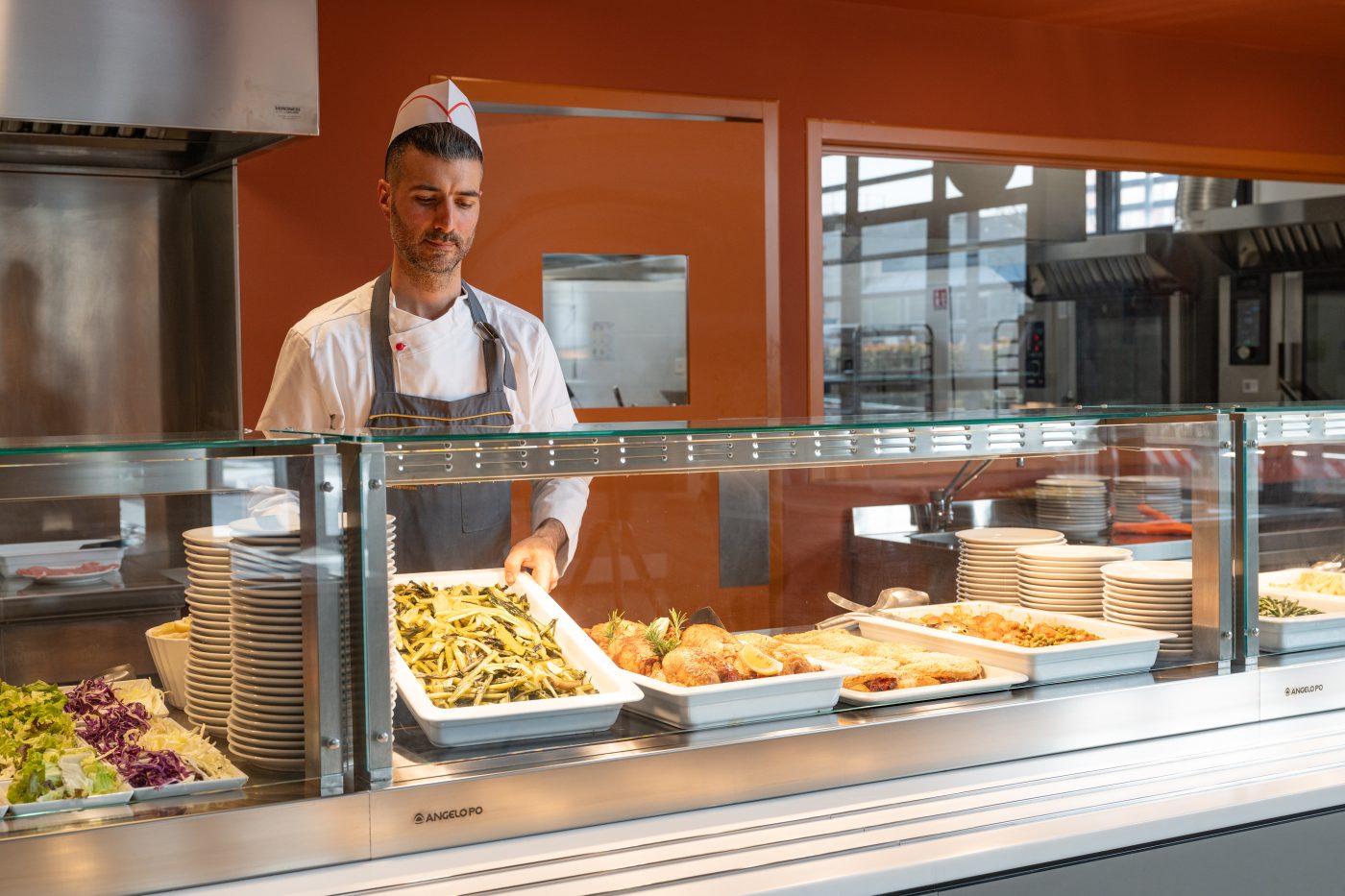
Speaking of responsibility, it reminds me that we have found a key that can help us communicate everything behind these projects, that is, what they mean when we develop a project and first train our staff, so they understand what it means, for example, to prepare a menu with a reduced environmental impact. Because it should not be taken for granted. I am thinking, for example, of the “Impiatta l’Impatto” project, the latest one we presented in school catering, which started as a pilot in commercial food service. As I was saying, we used it to train our colleagues, because it is our colleagues in food service – in a self-service restaurant or a kitchen – who are in direct contact with our customers, so they need to really understand what lies behind a project like this in order to pass it on to the customer.
Alessandra Zamagni:
It is a way to train people but also, at the same time, a way to respond to the requirements set by regulations and environmental policy. You applied the product environmental footprint to assess the impact of the menu, so we are already heading in the direction the European Commission is asking for, and that the new farm-to-fork strategies require. So there is already alignment with what the future – not too distant, I’d say quite close – will ask of us. At the same time, by also working on communication, you are doing so in line with the criteria that will be required for communication that is as transparent as possible and avoids so-called greenwashing, because unfortunately today we have seen a certain lightness in several cases in tackling issues of this kind. I’d say this has been a productive conversation.
Paola Bertocchi:
Thank you, it’s been a pleasure.
Alessandra Zamagni:
Thank you, Paola, until next time.
Paola Bertocchi:
Thank you, Alessandra, bye.