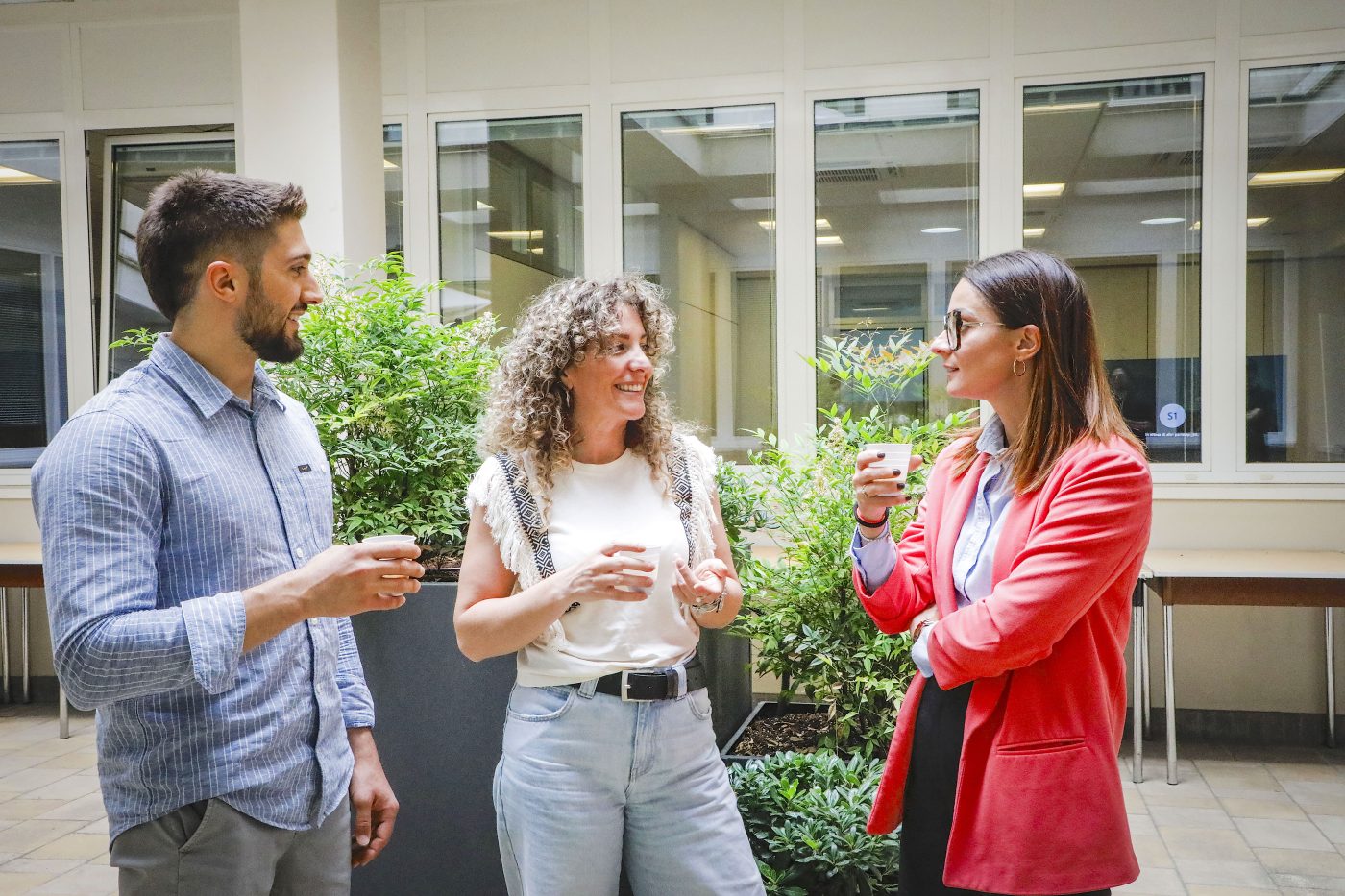

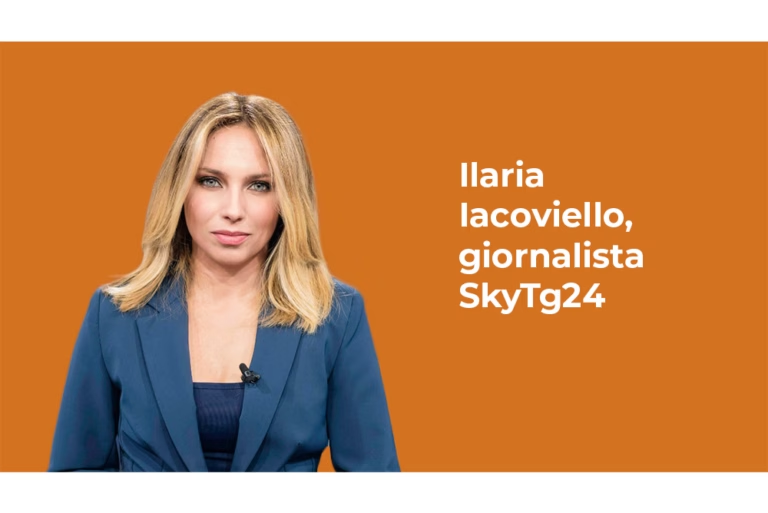
A journalist and presenter for SkyTg24, she focuses mainly on education and social issues and is the author and curator of the programme “Ragazzi interrotti” (Interrupted lives). In this podcast she describes the lives and difficulties of children and young people during the pandemic, highlighting the value of school as a place not only of learning but also of socialising, relationships and opportunity.
Voiceover:
Welcome to Voiceover, the podcast series produced by Camst group to share good sustainability practices: an episodic account of professional, life and activist experiences, told in the voices of the people who lived them.
Ilaria Iacoviello:
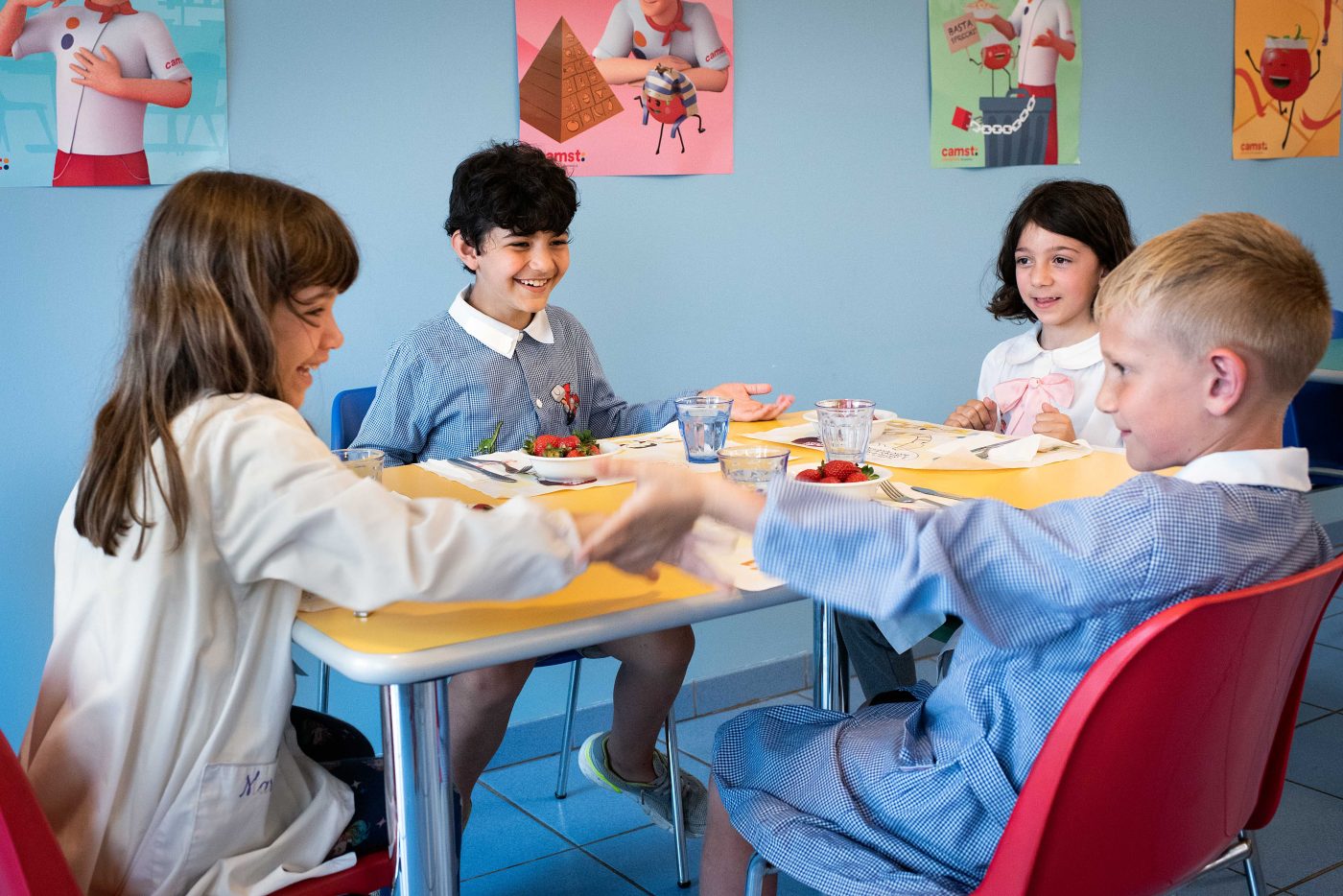
I’m Ilaria Iacoviello, a journalist at Sky TG24. “Mum, I didn’t really like what I ate at school today. The meatballs were good, the courgettes so-so, but the pasta, no, not at all.” “Mum, everything was delicious today, don’t worry, I won’t eat again at home, so you – since you’re not a great cook anyway – are off the hook.” My son Francesco spares no one when it comes to food, and neither do his classmates, who from the very first days of school, besides choosing which park to go to for a kickabout, would comment on what was for lunch and what they would have liked to eat. Of course, I could have just shown them the app with the daily menus, but imagine the arguments. Anyway, I had never noticed it before, or at least not so clearly, but the canteen really is one of the topics that brings children together most. I don’t know if it’s the same in your classes and your schools, but for us it’s a real must. Yes, because for them it represents everyday life, their way of being protagonists in what may seem to us like little things. And so you picture them at their desks looking at courgettes and carrots, pasta with tomato sauce, meatballs in sauce and who knows what else. In times of Covid, even this is enough to painstakingly recover that normality which just a year and a half ago seemed irretrievably lost. And yet it was our children, first of all, who taught us that you can find beauty in small things, despite remote learning, masks and distancing. Oh yes, hand sanitiser and all the new words we have learned. I often watched them queuing in their masks at the school entrance and exit, just as I was often told off by my son if my mask had slipped down a little. Think how mature children can be, and how mature young people have shown themselves to be in recent years. For example on vaccines, a topic I have often heard them discuss even with parents who were not so convinced: “we have to do our part too, so we’re getting vaccinated”. And to think that for months they were singled out as responsible, or among those responsible, for spreading the virus – months that were extremely hard for them, not only for adults struggling with remote working, for example. Months that we covered at Sky TG24 in a programme with a very telling title, “Ragazzi interrotti” – interrupted lives. Interrupted in their social life, in sport, in their confidence in the future, in the path to take, in the choices to make. Needless to say, these years of pandemic must make us reflect and must spur us not to repeat the mistakes of the past and to start again with much greater awareness. And if we are talking about young people, we cannot fail to start from the importance of school, which must return – and in fact is already returning – to the centre: the centre of political debate, but also the centre of a social system in which young people must finally be protagonists. Because school has a value that goes beyond textbooks and lessons in Italian, maths and science: school is life, and also a chance to get ahead. I am thinking, for example, of young people in the suburbs, but not only them, for whom contact with teachers has very often made the difference. “All it took was talking to them, even at break time, about anything at all, and looking them in the eye, to make me feel important.” That is what a boy told me, who nevertheless decided to drop out of school during remote learning, precisely because he lost that relationship with his teachers that was fundamental for him and many others. Looking each other in the eye is different from looking each other in the eye through a computer, because school is a second family alongside your family, and you risk getting lost if you don’t find the right path again, that sharing that goes beyond the classroom. This is what happened to many, given that our country, when it comes to early school leaving – although the 2020 figures are slightly better than in 2019, especially in the South – is still fourth in Europe for this phenomenon. We are at 13%, still far from the European benchmark of 10%, an area that will need work together with the fight against educational poverty. More and more children and adolescents are in fact showing marked signs of social, relational and behavioural distress. What struck me most were the figures on bulimia, self-harm and suicide attempts caused by anxiety, stress and depression. As regards bulimia, for example, in the most critical period of infections – the first year after the outbreak of the pandemic – admissions to facilities caring for young people with eating disorders grew exponentially. “I’ve always had a strange relationship with food,” a girl confided in me. “The first problems started when I was in middle school, then fortunately, with my family’s help, things changed. But shut within the four walls of my bedroom during lockdown, I started to feel lonely; I needed to find a way to let off steam. For me food had two faces: on the one hand it was a refuge, a safe haven; on the other, an enemy. Some days I tended to binge – I felt the need to, because it made me feel calmer. But then the guilt would come and I would force myself onto strict diets.” As you can imagine, this girl’s story is not an isolated case. In these years young people have often felt the ground give way beneath their feet. That is why we must start again from young people and listen to them – they who, despite everything, have shown great resilience. They who, despite remote learning, with sweatshirts or even pyjamas as their new uniforms, did not lose heart, trying to follow lessons on their mobile phones where a computer wasn’t available, often battling with the connection, fighting against that sense of loneliness that sooner or later overwhelms you when you are far from your classmates, from your usual routine, from everything that used to be your world – not forgetting love, which can overcome anything, even at a distance. Couples found ways too. Some did their homework on video calls, some tuned in to watch TV series together, some even organised class or school parties on social media. WhatsApp, Houseparty, Meet, Instagram: that’s how the time passed. Time that must not now be wasted. Alongside the more than 17 billion earmarked for education by Italy’s National Recovery and Resilience Plan (PNRR), it is necessary – I repeat it once again – to invest in young people, to give them the future they deserve and to give our country the future it deserves.