
We talk about sustainability in terms of culture and responsibility in preventing and eliminating food waste, in a shared process where companies become positive, proactive models of choices and actions so that everyone can improve the way they eat and consume food.
Mattia Grillini:
Hi Andrea, thank you for being here with us today. We have been working together for many years, and I think this is the right occasion to talk about an issue that is very close to our hearts: tackling food waste. What can you tell us, what is the situation today?
Andrea Segrè:
We started in 2010 at the European Parliament by asking Europe – and then it became the world – to halve food waste. In fact, in the UN Agenda for Sustainable Development – we are now approaching 2030 – this request became global: reduce food waste by 50%. The latest figures we presented together tell us that household waste is still around 30 kg per person per year. That may not sound like much, but if we multiply it by the value of the still-good food we throw away at home, we are talking about around 7 billion euros. The work we are doing now is to estimate waste outside the home as well, where there is no data. In food service, for example institutional catering, including canteens and especially school canteens, this is very important because it is a small or medium share that must be reduced.
Mattia Grillini:
What we have chosen as the main way to act on this issue is to develop educational projects. In other words, alongside monitoring and attention to waste, in the many schools where we work there are also workshops, projects and meetings with families to tackle these issues.
Andrea Segrè:
In the surveys we carried out – and this is why we focused on consumers – it is very often a matter of little awareness of the mistakes people make without realising it. That is why we also moved into behavioural economics as a research area. Nobody throws food away on purpose; there are reasons that somehow need to be uncovered and understood, so that we can then work on prevention – the best waste is the waste you don’t produce. And this is in view of the efficiency and sustainability of the whole agri-food system. Where does prevention happen? In schools. Through what tool? Food education.
Mattia Grillini:
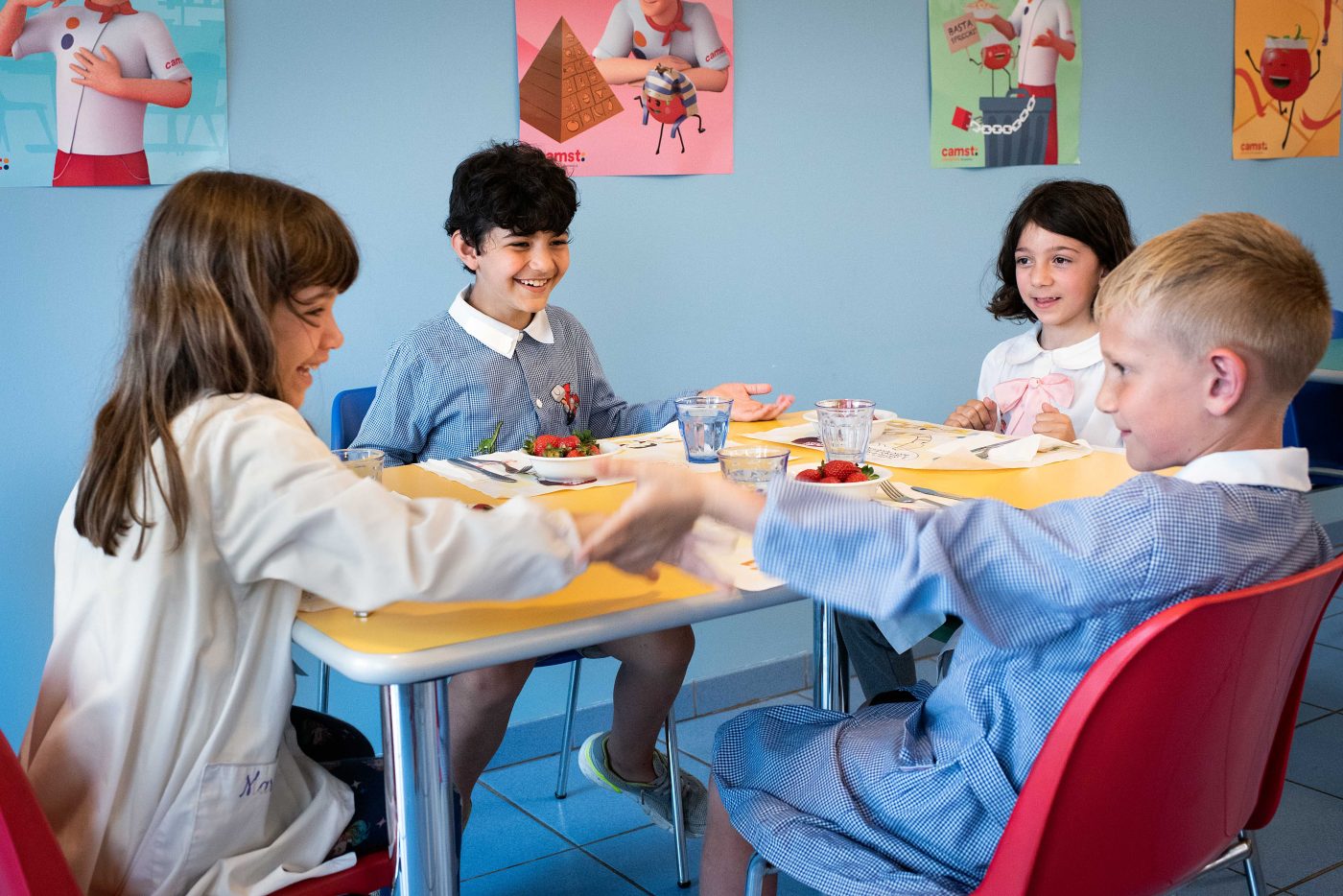
We increasingly see that alongside our school catering offer – which means bringing children a quality meal that is good, enjoyable and nutritionally balanced – there are more and more workshops, educational projects and pilot schemes that also serve to convey the educational value of a meal. Among the many projects we have worked on together, the most recent is certainly “Sprecometro”, which came from a brilliant idea. If you remember, two years ago when you presented it in Rome, I came up to you and said “OK, we have to bring this into schools”, because it really does become a tool.
Andrea Segrè:
We managed to build into an app a solid survey component that lets you understand how much you waste and why. Basically, you fill in a questionnaire, you find out your profile, and at that point the app gives you a classification with the obvious aim of reducing waste. My goal was to become thrifty within a few weeks. The app then immediately gives you a figure in euros so you understand, say, if 50 grams of cheese are left in your fridge – that shouldn’t happen, but suppose it does – it tells you straight away how much you spent, plus the water footprint and the carbon footprint, so you immediately understand the effect that letting cheese go mouldy has on your wallet and on the environment. This is how we engage young people, who can do it on their own or in a group – think of a class, which is what we are developing – so that we can then see how the group, the class, the school, the family, the city and the country move towards this goal.
Mattia Grillini:
We have a concrete opportunity to influence habits, consumption patterns and the way people approach food correctly and properly, which is what can be done in collaboration with institutions and the world of education. So my hope and my intention is to continue this collaboration and perhaps keep coming up with something new, precisely because this issue is central to our society.
Andrea Segrè:
Building paths with partners that start out one way and then change, adding new pieces that come from experience – that helps you grow, so it is mutual. It is certainly useful for you, but believe me, it is useful for us too.
Mattia Grillini:
Andrea, thank you for everything, and let’s meet again soon to continue these wonderful and very useful projects.
Andrea Segrè:
Thank you. Excellent, we will have results that will be great to share with everyone.
In this episode we focus on the fight against food waste and the importance of education in schools, through a dialogue between Mattia Grillini (Camst group) and Professor Andrea Segrè (founder of Last Minute Market and the Spreco Zero campaign). The discussion looks at data on household and out-of-home food waste, particularly in institutional catering and school canteens. By applying principles of behavioural economics and using innovative digital tools such as the Sprecometro app, the episode shows how everyday awareness can be turned into concrete actions for the environment and for our wallets.