
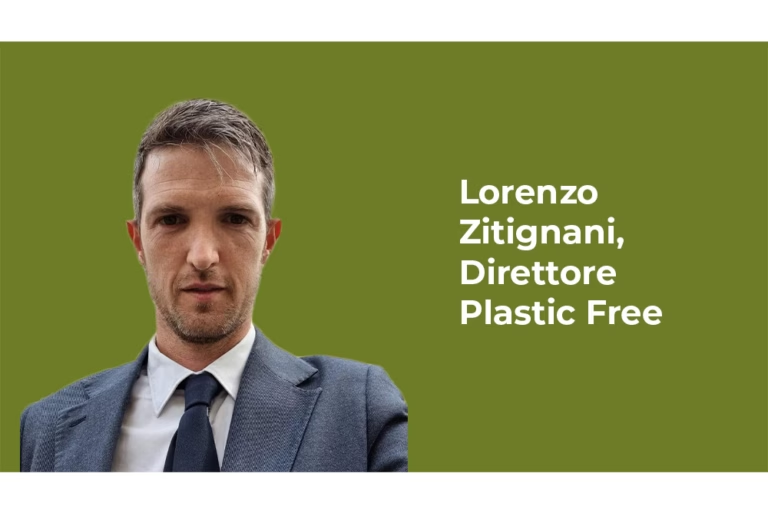
Director of Plastic Free, an association active in the fight against plastic pollution, Lorenzo Zitignani explains the role companies must take on today to be an active part of change, making a concrete commitment to phasing out single-use plastics. With one watchword: every small gesture can make a difference.
Massimiliano Colletti:
There is a photograph that went around the world: it shows a seahorse in the middle of the ocean clinging with its tail to a cotton bud. It was taken in Indonesia by Justin Hofman, who won Wildlife Photographer of the Year in 2017 with this shot. Why does this photo work so well? Because it clearly conveys a simple idea: that plastic should not be there.
Voiceover:
Voiceover: stories, good practices, sustainability. A Camst group podcast produced by Melting POD.
Massimiliano Colletti:
I’m Massimiliano Colletti, and today I’ll tell you the story of Plastic Free, an organisation that believes, just as clearly, that much of the plastic we produce should not exist.
Lorenzo Zitignani:
The culture is changing. This is extremely important, and culture is the only weapon we have to try to reverse this trend, partly because we don’t have many alternatives – there is no planet B. Either we do this, or before long there will be no fish left in the sea. There’s no escaping it.
Massimiliano Colletti:
That was Lorenzo Zitignani, co-founder of Plastic Free, a volunteer association founded in 2019 to inform people and raise awareness about the dangers of plastic.
Lorenzo Zitignani:
As often happens, it started from an almost chance meeting. I was collecting plastic in Lampedusa with my partner. We then found a stranded turtle which, as the autopsy later showed, had swallowed 18 kg of plastic. That’s when we decided we had to do something. At the same time I noticed a newly created Facebook page, Plastic Free, set up by Luca De Gaetano, a young man from Termini whom I had never seen or met. I wrote to him straight away. We got in touch; he said “look, I have this idea” – “so do I”. We met in Bologna, had lunch, and that’s how it began. He had already created the logo and everything; we met and from there we built this association. Why was it founded?
It was founded to raise awareness among as many people as possible about plastic – plastic not as an object in itself. Plastic is behind the only Nobel Prize in chemistry we have
in Italy, Natta’s, so plastic in itself does nothing wrong: it is the relationship between people and plastic that has seriously upset the balance of nature. We produce too much of it, there is too much of it around, and we don’t know how to manage it. The real problem, though, is that people don’t know this – many don’t. It’s not that they throw it on the ground to spite anyone; they simply don’t think about what it can cause. People say: if you’re in Bologna, it won’t end up in the sea. No, that’s not how it works. Consider that most of the nanoplastics in the sea come from tyre dust – just to show you how far it can travel. So that is the first objective: raising awareness. Second, we needed to combine it with something concrete, so we started running projects. The first was the clean-up project: this army of blue shirts that, practically every day or every week, goes out to collect waste and clean up parks, beaches, mountains, hills and the sea all over Italy, and now in much of Europe too. To date we have collected, and therefore removed from the environment, more than two and a half million kilos of waste. It’s an enormous figure.
Massimiliano Colletti:
Concrete actions with a concrete effect, then. But how do you involve more and more people, to the point of changing mindsets?
Lorenzo Zitignani:
First of all, we try to follow the first principle of associations, which is to include rather than exclude. So anyone can take part in our clean-ups, even non-members. This creates a great network. Then we try to bring in as many people as possible. How? One way, as we said, is the clean-ups, but not everyone likes to go out in a group to pick up other people’s rubbish. So we tried other projects, like walking: ecological and tourist walks. For example, we did a walk along the “Via degli Dei”, the route you can take from Bologna to Florence, and we cleaned up that whole landscape. We did it all over Italy, creating various routes. Or plogging, for people who want to go for a jog, get some exercise and clean up places at the same time. On top of this we needed a part with children – it sounds like a cliché, but they are our future – and an emotional part. We pursued the part with children by running awareness activities in schools at several levels: primary, lower secondary and upper secondary. Children are sponges. I see my daughter, who is nine, almost ten: she has become a tractor – practically nothing gets past her on the beach. If she’s there and there is plastic, the plastic disappears. And I see that she tells her little friends too, because for them it’s a game, but a game that becomes everyday life and becomes awareness. That plastic must not be there. If it is there, it’s wrong, so I have to remove it. Whether it’s mine or not doesn’t matter at all: I pick it up and remove it. The second, emotional part is the turtles, which are something of a symbol for us. Why? Because the turtle is an ancient animal and probably the first animal to suffer from the problem of plastic in the sea. Plastic in the sea never decomposes: we have plastic, microplastic, nanoplastic. When it becomes nanoplastic it enters the food chain. What happens? Turtles are short-sighted; they don’t see well. They love jellyfish, and they mistake plastic for jellyfish. So we decided to try to defend and protect this animal. We have a turtle rescue centre in Calimera, in the province of Lecce, and we work with another one, the Fondazione Cetacea centre in Riccione. These centres nurse them back to health. It takes many months, but believe me, it shows people how human impact is ruining an animal that has existed practically forever, and that sticks in people’s minds.
Massimiliano Colletti:
Awareness and involvement are the key words for achieving a real impact on the planet. So what actions can companies take to be an active part of change?
Lorenzo Zitignani:
We have a dedicated department that deals specifically with partnerships with companies. We also have companies that support us in certain ways, making donations with which we create projects. These range from team building, which here too serves to raise awareness among the company’s employees, to companies with which we create projects to pollute less – raising awareness, but also polluting less, so something more practical. We also ran a campaign not only on plastic but on collecting cigarette butts, which was hugely successful because we put all the cigarette butts into tubes, and people could see that in an area of perhaps 10 square metres a tube filled up with nothing but cigarette butts. When we run these programmes with companies, we also make them realise the impact that something as simple as a small bottle of water can have. A very simple example: all of us, at least once in our lives, have bought a small bottle of water and kept it at the office, right? If we multiply that by the number of companies – not in Italy, let’s say just in Emilia-Romagna, to keep it low – and by all their employees, imagine: one small bottle a day per employee. It’s a staggering ecological impact. So we try to push them towards a more sustainable choice. Because it’s not just the bottle: it’s the bottle, the label, the cap, the wrapping, the transport, the pallet, the tyre dust I mentioned earlier. I could give you the example of soaps: using biodegradable soaps, and perhaps not single-dose ones, so to speak, because that too has a very strong impact. Or for companies that do laundry, for example, choosing 100% cotton materials without plastic microfibres, because here too washing-machine filters don’t hold back microfibres, so everything flows away and ends up in the sea. With companies that provide food services, here too we try to say: don’t give out plastic cups. It is always material to be disposed of; you can’t keep up with it, and we don’t even have the plants to handle all this material for recycling. Consider that in Italy we are actually quite good and recycle about 40%, but the global figure is 14%, which is very little. The estimate is one truckload of waste dumped into the sea every minute.
Massimiliano Colletti:
The last point I want to discuss with Lorenzo Zitignani is bureaucracy, which can sometimes get in the way even when actions are taken with the best intentions.
Lorenzo Zitignani:
We have found that many municipalities, especially at the mouths of large rivers such as the Po, where very large quantities of waste arrive, support us but have a disposal problem, because the cost falls on them in terms of local taxes. All the waste we collected at the mouth of the Po falls on the municipality at the river mouth. So mayors also find themselves in great difficulty, because they say: “Guys, we want to support you, we fully embrace the cause, thank you for what you have done so far, but this way I’m forced to raise the waste tax.” This is a problem we have also tried to raise with the Ministry of Ecological Transition, to prevent an ecological action from then becoming an economic problem for citizens – otherwise it’s a vicious circle. We would be solving one problem and creating another, and that is certainly not the goal.
Massimiliano Colletti:
That’s the end of this episode. That’s all from Massimiliano Colletti. Bye!
Voiceover:
You’ve been listening to Voiceover: stories, good practices, sustainability. A Camst group podcast produced by Melting POD.