









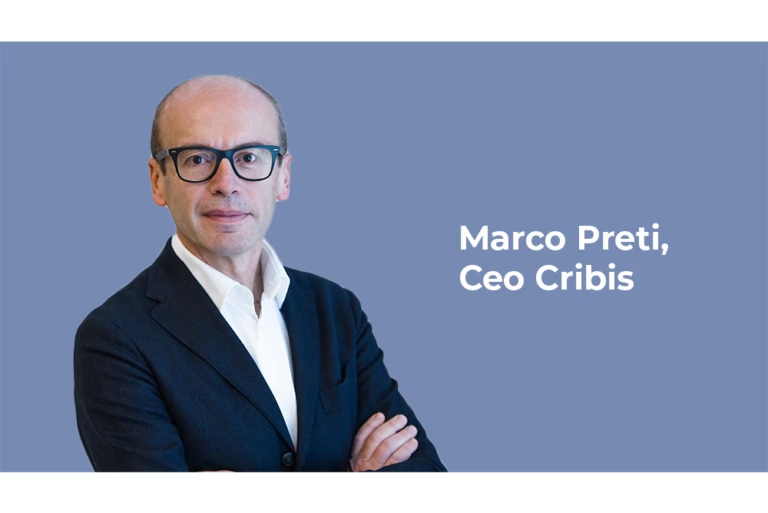
CEO of Cribis, a CRIF Group company, for more than ten years, Marco Preti is responsible for business development in Italy and abroad. In this interview he explains how business growth – impossible today without an integrated sustainability strategy – can only be achieved by looking at the entire supplier chain.
Massimiliano Colletti:
Take a glass of crystal-clear, perfectly pure water. Now drop into it a single small drop of black ink. Done? Great: now that water is no longer clear.
Voice over:
Voiceover: stories, good practices, sustainability. A Camst group podcast produced by Melting POD.
Massimiliano Colletti:
I’m Massimiliano Colletti, and today I’ll explain why, while it is important to monitor the sustainability of your own company, it is just as important to do so for your entire supplier chain, so as not to tarnish all the work you have done.
Marco Preti:
Today, having a supplier that does not behave correctly also harms me, directly engaged as I am, because I certainly suffer a disadvantage: people will certainly say that it is my supplier, and so I get somewhat drawn into the wrongdoing that this party may commit in Italy or in other countries.
Massimiliano Colletti:
That was Marco Preti, CEO of Cribis, part of CRIF, a company specialising in credit information.
Marco Preti:
CRIF is a multinational based in Bologna, because that is where we were founded a little over 30 years ago. We are now present in 40 countries on 4 continents. We work with information: we manage information on behalf of our clients, whether it is needed to assess credit and creditworthiness or to find new customers in turn. And the latest range of services we have launched relates to sustainability.
Massimiliano Colletti:
You will probably have heard of the acronym ESG, which stands for Environmental, Social and Governance: three criteria for measuring your impact in environmental, social and corporate governance terms. So why is it important to monitor all these parameters?
Marco Preti:
The reason why it is important to measure your ESG starting point is that, when it comes to sustainability, no one can say they have arrived. No one can say they are compliant with the rules, as happens with many other business aspects where you comply with regulations and reach a level where you can say “I have done everything I had to, now I am compliant”. Sustainability is a journey: all companies are on a journey towards ever greater sustainability. Measurement is fundamental because if I don’t know where I am starting from, I don’t know where my journey begins and, above all, where it might end. So it is important to do this in terms of absolute measurement.
Massimiliano Colletti:
To assess companies against ESG criteria, CRIF has launched a digital platform with the aim of creating an international measurement standard.
Marco Preti:
It is a digital platform called Synergy, because we are firmly convinced that at a time when thinking about corporate sustainability is just getting started – since there are no standards or rules to refer to – it is very, very important to find a baseline measure of each company’s ESG level. Since this is our job, and we are an independent third party tasked with doing this and recognised as able to carry out this type of assessment, we have this expertise and we have launched this new tool. Its purpose is precisely to minimise difficulties. It is aimed at all types of companies, small or large. We designed it precisely to make completing this sustainability questionnaire easy and sustainable too. We have designed this questionnaire for all the countries in which we are localising it. We are launching this project in 20 different countries around the world, so it is becoming a global project that starts from Bologna, from CRIF, and that for the moment has no other competitors. So we are very proud of what we are doing, even though it is very demanding and involves very significant investment. It is a questionnaire that is truly aimed at everyone and should make it easy to measure, to
benchmark, to understand the gaps between my suppliers and, above all, to give the supplier itself, the company itself, all the elements needed to understand what can be done to improve its ESG score. We believe that sustainability should not be a cost but an opportunity, whereas having many standards and many different requests from each of my clients
does become a cost, because in the end I have to answer the same questions and redo the same things in slightly different formats “n” times. We believe that if we can simplify things, or all have the same acceptable tool, measurement improves and, above all, everyone refers to a single model, a single number, and this could really help spread this culture and this way of approaching
sustainability in business.
Massimiliano Colletti:
But a company does not live in isolation from the context in which it operates. What is the risk of having suppliers or a supply chain that are not equally virtuous?
Marco Preti:
If I have a supply chain, that is, my suppliers, as a company I have every interest in
knowing how they behave in terms of sustainability, because today companies are investing a great deal in sustainability and above all in communicating what they are doing on sustainability. If one of the suppliers were ever to behave in a completely different way, there would be a reputational impact. It is clear that as a company I have to take responsibility for what my suppliers do, because very often the supply chain – and this is very clear from an environmental point of view – may have a much greater impact than I do. I might run my business in a high-tech office powered by sun and wind, with perfect contracts because there are only twenty of us, while behind me there is a supply chain that can cause disasters from every point of view. I must look not only at what I do as a company but at how I do it. My suppliers are part of my production process. I cannot pretend not to know.
Massimiliano Colletti:
The horizon, then, is a virtuous chain reaction, where larger companies influence smaller ones through their choices, and these in turn do the same, and so on.
Marco Preti:
As a citizen, as a person, it will create that feeling of: if I want to keep supplying my client, I have to pay attention to certain sustainability factors; but then, besides being a supplier, I also have a supply chain of my own, and I must make sure they are careful too, because otherwise I cannot say I am fully compliant. If this concept spreads like a network, then we really will have done something with a very important impact in terms of overall sustainability. And what I can say is that a great many companies are
thinking about it. It is not something that will arrive who knows when; it is happening, and I think that is a positive message. Companies are usually seen as more concerned with generating revenue or margins than with how they do it. That is no longer the case. Attention to the path taken has truly changed, but it all comes from this: as a consumer, I want to buy from those who take the right approach to sustainability.
Massimiliano Colletti:
It’s time for us to say goodbye. That’s all from Massimiliano Colletti, until the next episode.
Voiceover:
You’ve been listening to Voiceover: stories, good practices, sustainability. A Camst group podcast produced by Melting POD.