



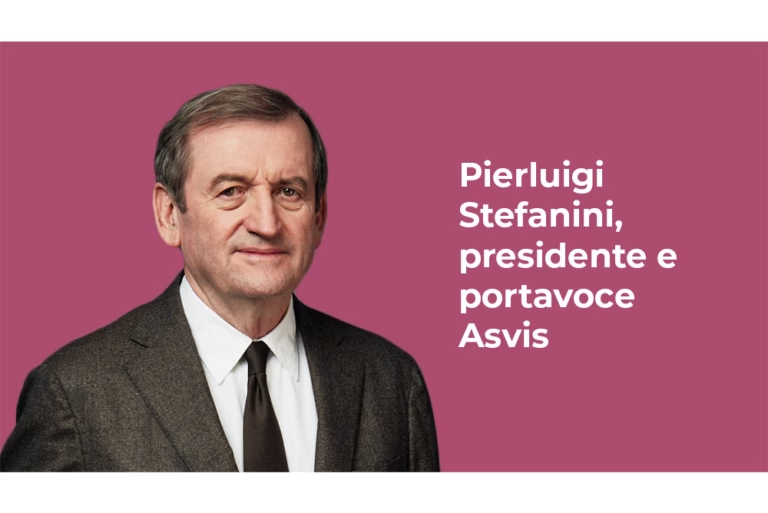
Why is a sustainable company also a healthier, better-performing company? Pierluigi Stefanini, President of ASviS (Italian Alliance for Sustainable Development) and an authoritative voice on the SDGs, reflects on the goals of the 2030 Agenda, focusing on Goal 17 and showing how – through partnerships between organisations working towards a shared objective – economic and social sustainability can be balanced with environmental sustainability.
Massimiliano Colletti: On 25 September 2015 the United Nations approved a plan for sustainable development: a global action plan for people, planet and prosperity. You will certainly have heard of it: it is known as the SDGs, the Sustainable Development Goals, or more simply as the 2030 Agenda, where 2030 is the deadline for achieving the goals – 2030, precisely, eight years from now.
Voiceover: Voiceover: stories, good practices, sustainability. A Camst group podcast produced by Melting POD.
Massimiliano Colletti: I’m Massimiliano Colletti, and today we’ll talk about the 2030 Agenda, the little time we have left to achieve it, and how businesses are being called on to step up their contribution.
Pierluigi Stefanini: We cannot joke about the climate crisis; it is not allowed. It is no coincidence that the UN Secretary-General recently highlighted a very sensitive point publicly: two years of pandemic and now the war are delaying the effectiveness of policies to achieve the goals of the 2030 Agenda. So we have an absolute duty to speed up this process, to commit more, to be consistent – and it is difficult for everyone.
Massimiliano Colletti: That was Pierluigi Stefanini, President of ASBIS, the Italian Alliance for Sustainable Development, which since 2016 has had the specific goal of raising awareness of and action on the 2030 Agenda in society, business and institutions.
Pierluigi Stefanini: I think it is important to highlight three aspects that characterise that work, which took years to develop. A universal approach: we must have an overall vision of the planet and its future. An integrated approach: knowing that if we want to address the problem of jobs for young people, we must do so by investing in education and training, through far-sighted social and health policies, through fundamental investment in research – and I could go on. The third dimension is participation, which means strengthening democracy, another key element. In this epochal, so difficult and complex crisis, we need to invest in democracy.
Massimiliano Colletti: So, where do businesses stand with the 2030 Agenda?
Pierluigi Stefanini: Over time, greater awareness, greater willingness and also commitment in this direction has grown and is growing in the business world. One thing should be said: this is especially true of medium-sized and large companies, starting with the big conglomerates, the large groups dealing with consumer goods, those committed to renewable energy, and I could give other examples. Over the coming months and years we must work to extend, deepen and involve more widely the different types of businesses: smaller ones, including sole traders, craft businesses, service companies and small farming businesses. So we need wide-ranging work that uses large companies – and this is another key point – because every large company deals with many suppliers of services and products. So if every large company commits to involving its network of suppliers, building shared design together, that will be a fundamental lever. Finally, there is a further decisive lever that Europe is proposing to us, and in which we must invest more quickly and with greater commitment: promoting – and it is doing so with good reason – tools, measurements, incentives and guidance that involve businesses and make them consistent. Because what is the risk? That many companies declare themselves sustainable, but then we have to see whether this consistency actually shows and takes hold in everyday behaviour. So we also need to build a shared control system between institutions and the private sector to make sure these processes are credible, believed and, above all, effective.
Massimiliano Colletti: Not all businesses face the same challenges. What are the critical issues for a sustainable transaction at every level?
Pierluigi Stefanini: There is objectively a critical aspect that also needs to be managed. It is no coincidence that Europe also offers us important ground here, having set aside resources for a just transition. What does that mean? It means that those working, for example, in the coal or oil sectors face a very important and difficult transformation; it is very complex, hence the need to support and foster these evolutionary, transformative processes. Under the Paris Agreement – another very important chapter, in 2015 – we have the goal of reaching net-zero emissions by 2050. Europe also says that by 2030 we must reduce emissions into the atmosphere by 55%, and hence the transformation process for these large oil and coal groups… Let me give another example close to these. Europe says that by 2035 – and every country is committed to reaching this goal – combustion-engine vehicles will be phased out across all private vehicle segments. Do you understand what this means in terms of change? And of transformation of the car industry? So there are more exposed sectors that also need incentives, support and mitigation of impacts, including from a social point of view, because of the risk of job losses; so we need to find the smart and fair response to foster this transformation.
Massimiliano Colletti: The goals of the 2030 Agenda are ambitious and universal, and all the actors involved – governments, businesses and civil society – are called upon by the Agenda itself, in Goal 17, to work together to achieve them.
Pierluigi Stefanini: COL 17 is very important because it is, so to speak, the umbrella that sums up the whole Agenda in some way. And what does it say, in short? That to build these responses, to achieve these goals and to contribute to this transformation, we need fundamental investment in partnership, collaboration, sharing and – I stress – cooperation. It is clear, then, that large companies have an important responsibility. It is no coincidence that Europe is issuing a new directive aimed at measuring, through due diligence by medium-sized and large companies, how they behave with their suppliers and their value chains with regard to human rights and the protection of the environment – making sure their policies are consistent, measurable and adequate to meet these needs. On human rights, in many parts of the world we still have serious situations of suffering, exploitation, hardship and inhumanity, and so here there is a task for everyone; it is not something only a few can take on. We must all build responses together, each doing our part, so that human rights are truly consistent with the fundamental charters approved shortly after the Second World War.
Massimiliano Colletti: Well, it’s time to say goodbye for this episode too. That’s all from Massimiliano Colletti. Bye!
Voiceover: You’ve been listening to Voiceover: stories, good practices, sustainability. A Camst group podcast produced by Melting POD.